Cleanroom Classification: ISO 14644-1 Classes 1 to 9
ISO 14644-1 cleanroom classes 1 to 9: particle limits per m³, the class formula, FED-STD-209E equivalents and which ISO class each pharmaceutical room needs.
PharmaTwin Team9 min read
- ISO 14644-1
- Cleanroom Classification
- Particle Limits
- Cleanroom Design

Cleanroom classification is the grading of a room's air cleanliness by the maximum number of airborne particles allowed per cubic metre. Under ISO 14644-1:2015 there are nine classes, from ISO 1 (cleanest) to ISO 9, and each step down the scale allows ten times more particles: an ISO 7 room may contain up to 352,000 particles of 0.5 µm or larger per m³, an ISO 8 room up to 3,520,000.
The ISO class says nothing about microbes, pressure or gowning. Pharmaceutical plants layer the EU GMP grades A to D on top of it, so a designer needs both scales and the link between them.
Key takeaways
- ISO 14644-1:2015 defines nine classes by particle concentration per m³, measured at one or more sizes between 0.1 µm and 5 µm.
- Every limit comes from one formula, Cn = 10N × (0.1/D)2.08, rounded to three significant figures.
- Since the 2015 revision, ISO 5 has no ≥5.0 µm limit; charts still showing 29 particles/m³ quote the 1999 edition.
- FED-STD-209E Class 100, 10,000 and 100,000 correspond to ISO 5, 7 and 8; the US standard was cancelled on 29 November 2001.
- A class is only meaningful with its occupancy state: as-built, at-rest or operational.
The nine ISO classes and their particle limits
Each ISO class sets a maximum concentration of particles equal to or larger than a given size, in particles per cubic metre of air. Concentrations are cumulative: the ISO 5 limit of 10,200 at 0.3 µm counts every particle of 0.3 µm and above. Cells left empty in the standard are sizes where classification is not appropriate, either because counts would be too low to be statistically meaningful or too high to measure reliably.
| ISO class | ≥0.1 µm | ≥0.2 µm | ≥0.3 µm | ≥0.5 µm | ≥1 µm | ≥5 µm |
|---|---|---|---|---|---|---|
| ISO 1 | 10 | – | – | – | – | – |
| ISO 2 | 100 | 24 | 10 | – | – | – |
| ISO 3 | 1,000 | 237 | 102 | 35 | – | – |
| ISO 4 | 10,000 | 2,370 | 1,020 | 352 | 83 | – |
| ISO 5 | 100,000 | 23,700 | 10,200 | 3,520 | 832 | – |
| ISO 6 | 1,000,000 | 237,000 | 102,000 | 35,200 | 8,320 | 293 |
| ISO 7 | – | – | – | 352,000 | 83,200 | 2,930 |
| ISO 8 | – | – | – | 3,520,000 | 832,000 | 29,300 |
| ISO 9 | – | – | – | 35,200,000 | 8,320,000 | 293,000 |
Pharmaceutical facilities work almost entirely between ISO 5 and ISO 8, and classify at 0.5 µm and 5 µm because those are the sizes EU GMP Annex 1 uses. ISO 9 is roughly ordinary indoor air and is only applicable in the operational state.
Where the numbers come from: the class formula
Every value in the table is calculated, not measured. ISO 14644-1 gives the maximum permitted concentration Cn for class N and particle size D (in µm) as:
Cn = 10^N × (0.1 / D)^2.08For ISO 7 at 0.5 µm: 107 × (0.1 / 0.5)2.08 = 10,000,000 × 0.22.08 ≈ 351,700, which the standard rounds to 352,000. The same arithmetic gives 3,517 for ISO 5 at 0.5 µm, published as 3,520, and 2,925 for ISO 7 at 5 µm, published as 2,930. Two practical consequences follow:
- One class step is a factor of ten. Because N is an exponent, ISO 7 allows ten times the particles of ISO 6 at every size, and ISO 5 is a hundred times cleaner than ISO 7.
- Small particles dominate the count. The exponent 2.08 means that halving the particle size multiplies the limit by about 4.2. A counter channel set at 0.3 µm instead of 0.5 µm faces a limit almost three times higher, not a stricter one.
The standard also allows intermediate decimal classes (for example ISO 6.5) computed with the same formula, which is occasionally used for specialised equipment zones.
Why ISO 5 no longer has a 5 µm limit
ISO 14644-1:2015 removed the ≥5.0 µm limit for ISO 5 that the 1999 edition set at 29 particles/m³. At such low concentrations, a few large particles lost in the sampling tube or caught by chance decide pass or fail, so the result says more about sampling statistics than about the room. Where large particles still matter, the standard points to the macroparticle descriptor (M descriptor) as a complement to at least one other particle size.
Many vendor charts and some AI-generated answers still show "29" in the ISO 5 row. That figure is out of date for ISO classification. EU GMP Annex 1 (2022) made the same choice for Grade A, whose ≥5.0 µm limit is "not specified" for classification, while still expecting 5 µm particles to be monitored during operations.
FED-STD-209E classes and their ISO equivalents
FED-STD-209E named classes after the number of particles ≥0.5 µm per cubic foot, so "Class 100" meant 100 particles/ft³. Multiplying by 35.3 (cubic feet per cubic metre) gives about 3,530 particles/m³, close to the ISO 5 limit of 3,520. The US General Services Administration cancelled FED-STD-209E on 29 November 2001 in favour of ISO 14644-1 and 14644-2, but the old names survive in purchase specifications and US compounding practice.
| FED-STD-209E class | Particles ≥0.5 µm per ft³ | ISO class | ISO limit ≥0.5 µm per m³ |
|---|---|---|---|
| Class 1 | 1 | ISO 3 | 35 |
| Class 10 | 10 | ISO 4 | 352 |
| Class 100 | 100 | ISO 5 | 3,520 |
| Class 1,000 | 1,000 | ISO 6 | 35,200 |
| Class 10,000 | 10,000 | ISO 7 | 352,000 |
| Class 100,000 | 100,000 | ISO 8 | 3,520,000 |
The equivalence is nominal: the converted FED values are about 0.3% above the ISO limits, and the two standards use different sampling rules. Qualification protocols should quote the ISO class, the particle size and the limit, not the legacy class name.
As-built, at-rest, operational: the class depends on the state
An ISO class is incomplete without its occupancy state. ISO 14644-1 defines three: as-built (installation complete, no equipment or people), at-rest (equipment installed and running, no personnel) and operational (normal work with the specified number of people). People are the main particle source, so the same room typically sits one class lower in operation than at rest.
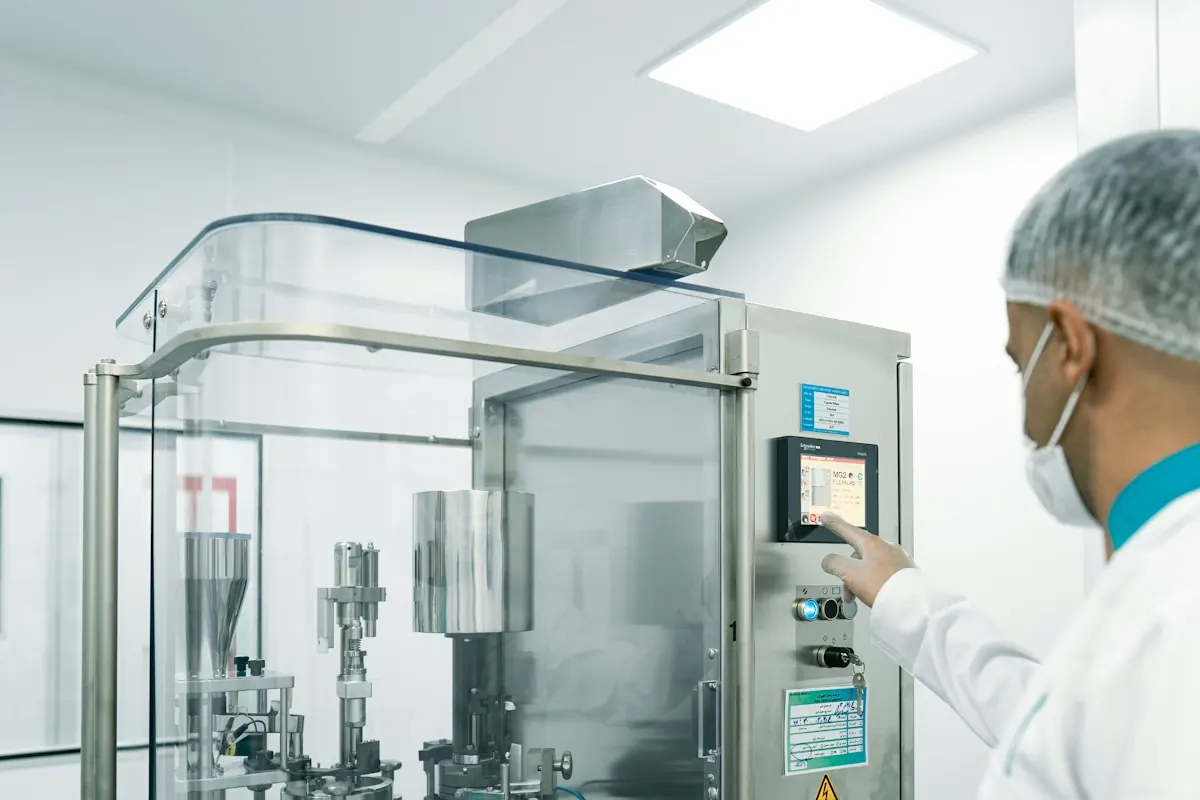
This is why EU GMP grades map to ISO classes in pairs. Annex 1 (2022) sets Grade B at 3,520 particles ≥0.5 µm/m³ at rest (ISO 5) but 352,000 in operation (ISO 7), and Grade C at 352,000 at rest (ISO 7) but 3,520,000 in operation (ISO 8). Only Grade A keeps ISO 5 in both states, which in practice requires unidirectional airflow over the critical zone. The grade-by-grade picture, with microbial limits and zoning rules, is covered in our guide to GMP cleanroom grades A to D.
Which ISO class each pharmaceutical room needs
The class follows the exposure of the product, not the prestige of the room. Annex 1 and the FDA's 2004 aseptic processing guidance converge on a short list of typical assignments for sterile manufacturing:
| Area | EU GMP grade | ISO at rest | ISO in operation |
|---|---|---|---|
| Aseptic filling, open sterile product, aseptic connections | A | ISO 5 | ISO 5 |
| Background room for a Grade A open process (RABS) | B | ISO 5 | ISO 7 |
| Solution preparation before sterile filtration, filling of terminally sterilised products | C | ISO 7 | ISO 8 |
| Component washing, less critical preparation, isolator background (minimum) | D | ISO 8 | Set by the manufacturer |
For Grade D, Annex 1 does not predetermine in-operation limits: the manufacturer sets them from a risk assessment and routine data. The FDA guidance, which uses ISO classes directly, expects ISO 5 in the critical area in operation and describes ISO 7 as typical for the supporting area around an aseptic line.
How a room is actually classified
Classification is a counting exercise defined by ISO 14644-1, Annex A. The number of sampling locations comes from the room area through Table A.1, the counter samples at least the minimum volume at each location, and every location must meet the limit. The minimum single sample volume, in litres, is:
Vs = (20 / Cn,m) × 1000where Cn,m is the class limit for the largest particle size considered. For ISO 5 at 0.5 µm this gives 20 / 3,520 × 1000 ≈ 5.7 litres; whatever the result, each sample must be at least 2 litres and last at least one minute. The 20 in the formula means that a room exactly at the limit would produce 20 counts, enough to be statistically usable. The 2015 edition also dropped the 95% upper confidence limit calculation previously required for one to nine locations. Test frequency and the wider qualification sequence are detailed in our article on cleanroom validation and ISO 14644 testing.
Particle counts are an outcome, not a design input. Whether a Grade C room reaches ISO 7 at rest depends on its supply airflow, filter coverage and recovery, which is why classes are usually set first and the air change rate is then calculated to deliver them.
Frequently asked questions
What is an ISO 7 cleanroom?
An ISO 7 cleanroom contains no more than 352,000 particles of 0.5 µm or larger, 83,200 of 1 µm or larger and 2,930 of 5 µm or larger per cubic metre, under ISO 14644-1:2015. It corresponds to the former FED-STD-209E Class 10,000 and to EU GMP Grade C at rest or Grade B in operation.
What is the difference between ISO 5 and ISO 7?
ISO 5 allows 100 times fewer particles than ISO 7: 3,520 versus 352,000 particles ≥0.5 µm per m³. In practice ISO 5 needs unidirectional airflow over the critical zone and is used for aseptic filling, while ISO 7 rooms use turbulent, HEPA-filtered air and serve as backgrounds or preparation areas.
What ISO class is a Class 100 cleanroom?
A FED-STD-209E Class 100 cleanroom is equivalent to ISO 5. Class 100 meant 100 particles of 0.5 µm or larger per cubic foot, about 3,530 per cubic metre, close to the ISO 5 limit of 3,520. FED-STD-209E was cancelled in 2001, so specifications should cite ISO 14644-1.
Does ISO 5 still have a limit for 5 µm particles?
No. ISO 14644-1:2015 removed the ≥5.0 µm limit for ISO 5 that the 1999 edition set at 29 particles/m³, because sampling losses and low counts make it statistically unreliable. Large particles can still be specified with the macroparticle descriptor, and EU GMP Annex 1 still expects them to be monitored.
Are ISO classes and GMP grades the same?
No. ISO classes cover airborne particles only, in one stated occupancy state. EU GMP grades A to D add microbial limits, at-rest and in-operation particle limits, and rules on gowning, transfers and monitoring. Each grade maps to an ISO class per state, for example Grade B is ISO 5 at rest and ISO 7 in operation.
How PharmaTwin helps
PharmaTwin is a pharmaceutical facility simulator in which each room carries its GMP grade and the corresponding ISO classes at rest and in operation. When a room's grade changes, its air change rate, pressure step and neighbouring airlocks are recalculated, so classification choices can be tested on the layout before the design is frozen. Final classification still rests on ISO 14644-1 testing of the built rooms.