Cleanroom Pass Box: Static vs Dynamic and Annex 1 Rules
What a cleanroom pass box is, how static and dynamic pass boxes differ, what EU GMP Annex 1 requires for pass-through hatches, and when to use an airlock.
PharmaTwin Team5 min read
- Pass Box
- Material Transfer
- EU GMP Annex 1
- Cleanroom Design
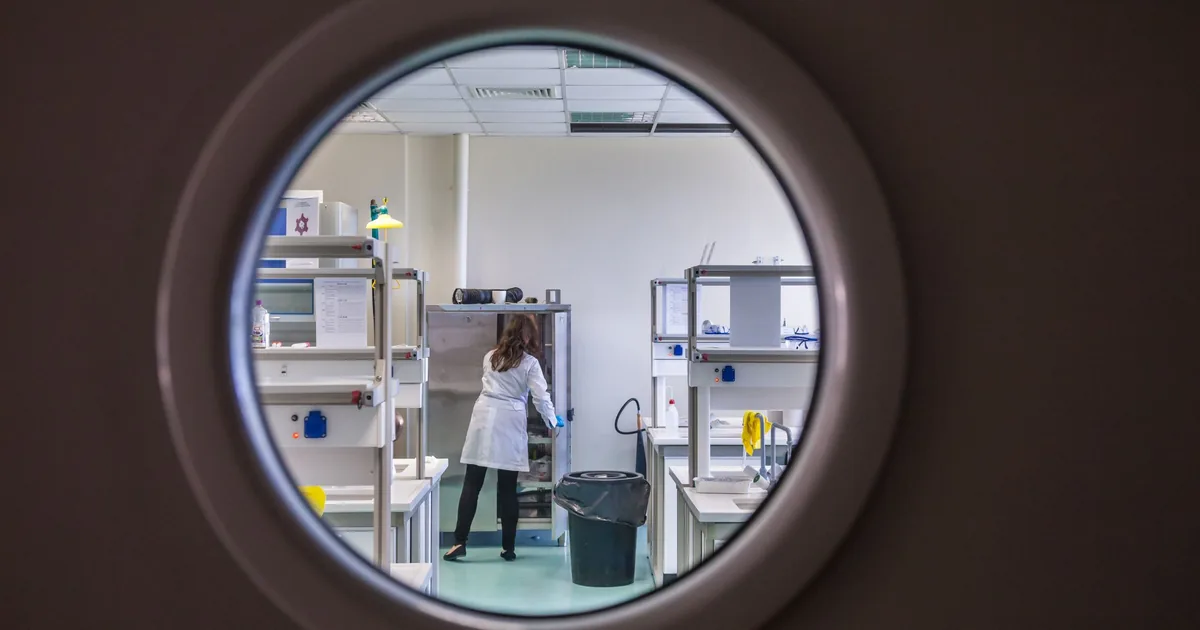
A cleanroom pass box, also called a pass-through box or pass-through hatch, is a small two-door chamber built into a cleanroom wall that lets materials move between two areas of different cleanliness without people crossing between them. Its doors must never be open at the same time, and in a dynamic pass box a fan and HEPA filter flush the chamber with clean air before the clean-side door is released.
EU GMP Annex 1 (2022) calls the transfer of materials into cleanrooms one of the greatest potential sources of contamination, so choosing and placing a pass box is a zoning decision as much as an equipment purchase.
Static vs dynamic pass box
A static pass box is a sealed, unventilated chamber; a dynamic pass box has its own fan and HEPA filter that flushes the chamber with filtered air. Static boxes suit transfers between rooms of the same grade or into Grade C and D areas. Dynamic boxes are the usual choice for entries into Grade B, where Annex 1 asks pass-through hatches to protect the higher-grade environment, for example with an active filtered air supply.
| Feature | Static pass box | Dynamic pass box |
|---|---|---|
| Air supply | None: chamber air is whatever entered with the last door opening | Built-in fan and HEPA filter flush the chamber before release |
| Door control | Mechanical or electrical interlock, or a visual/audible warning | Electrical interlock, usually with a timed purge before the clean-side door unlocks |
| Typical use | Same-grade transfers, Grade D to C, samples and documents | Entries into Grade B and other transfers where the chamber must reach the clean-side grade |
| Main drawback | No dilution of particles carried in with the load | Higher cost, filter and fan maintenance, periodic requalification |
What EU GMP Annex 1 requires for pass-through hatches
Annex 1 does not prescribe a pass box model, but section 4 of the 2022 text sets five rules that decide whether a static box is acceptable or a dynamic one is needed:
- Doors never open together. Entry and exit doors of all pass-through hatches and airlocks should not be opened at the same time. Airlocks leading to Grade A and B need an interlocking system; for Grade C and D, a visual and/or audible warning is the minimum. A time delay between doors can be added where segregation requires it.
- Protect the higher grade. Hatches should be designed to protect the cleaner side, for example by flushing with an active filtered air supply.
- Approved list for Grade A and B. Only materials and equipment on an approved list, assessed during validation of the transfer process, should enter Grade A or B through an airlock or hatch. Anything else needs pre-approval as an exception.
- Clean and disinfect on the way up. Items moving from a lower grade to a higher one should be cleaned and disinfected in line with the risk and the contamination control strategy (CCS).
- Sterilise where possible. For Grade A and B, items should preferably pass through a double-ended steriliser such as a double-door autoclave or depyrogenation tunnel. A pass box with a validated transfer disinfection is the fallback when sterilisation on transfer is not possible.
The hatch also sits inside the pressure cascade: Annex 1 gives a guidance value of at least 10 Pa between adjacent rooms of different grades, and a pass box must not create a leakage path that undermines it. The full text is in EU GMP Annex 1 (2022).
| Transfer route | Typical choice | Door control (Annex 1) |
|---|---|---|
| Same grade (D to D, C to C) | Static pass box | Doors never open together |
| Grade D to Grade C | Static or dynamic, per risk assessment | Visual and/or audible warning as a minimum |
| Grade C to Grade B | Dynamic pass box with filtered-air flushing | Interlock |
| Into Grade A | No direct pass box: sterilise through a double-ended steriliser, or protect wrapped items while crossing Grade B | Interlock at the Grade B boundary |
Pass box or material airlock?
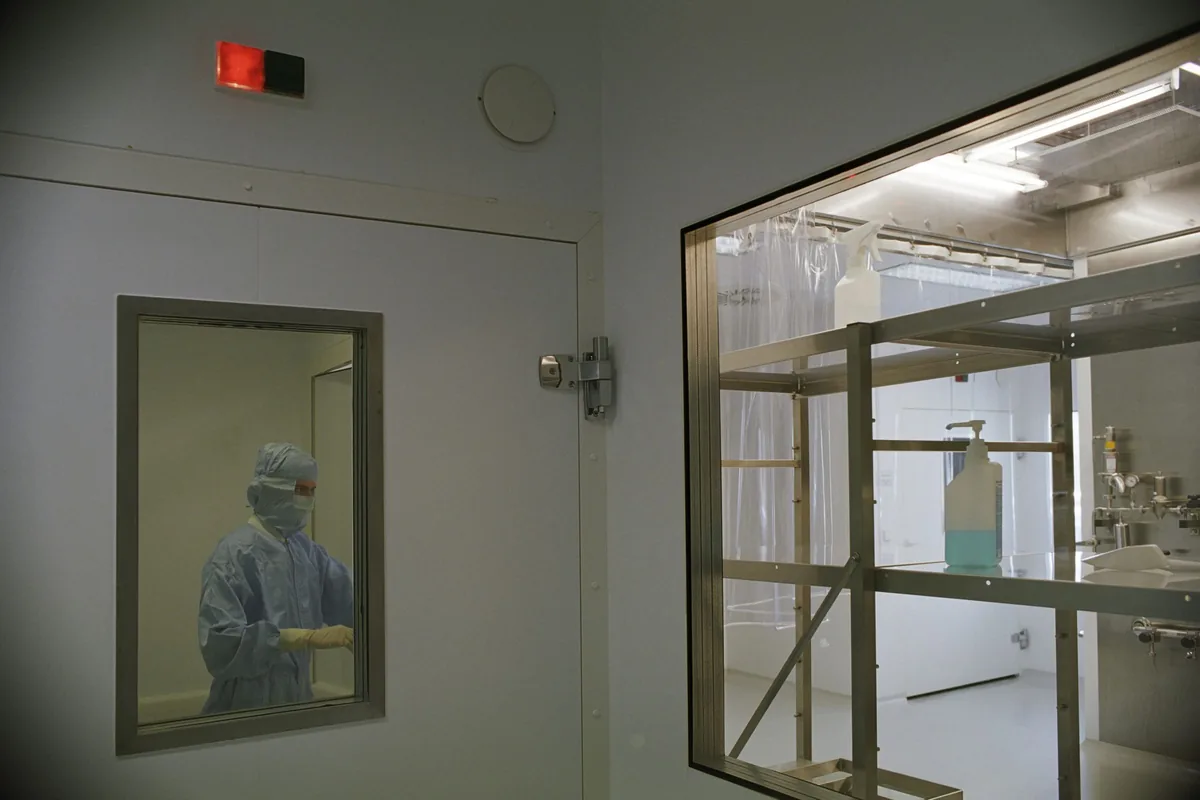
Use a pass box for items an operator can lift through a wall opening; use a material airlock when items arrive on trolleys, need unpacking or staging, or are too large to hand through. Annex 1 accepts both and sets no size threshold, so the choice comes down to how the transfer is actually performed:
- Size and handling. Containers that need two hands, a trolley or a lifting aid belong in an airlock.
- De-bagging and staging. If an outer wrap has to be removed in a controlled step, the space for it is an airlock, not a hatch.
- Direction. Annex 1 expects unidirectional transfer into Grade A and B, with a separate route for waste and samples where possible. Two hatches, one in and one out, are often simpler than time segregation.
Pass boxes therefore belong on the material flow diagram from the start, next to the cleanroom airlocks they complement, and should be checked against the routes described in our guide to pharmaceutical facility layout.
Frequently asked questions
Does a cleanroom pass box need an interlock?
Its doors must never be open at the same time. EU GMP Annex 1 (2022) requires an interlocking system for airlocks leading to Grade A and B areas and at least a visual and/or audible warning for Grade C and D. In practice, pass boxes serving Grade B are interlocked, while static boxes between lower grades may rely on a warning system.
Is a UV lamp enough to decontaminate items in a pass box?
No. UV-C light only treats surfaces in its direct line of sight and does not reach shadowed areas, crevices or the inside of packaging. Annex 1 expects items moving to a higher grade to be cleaned and disinfected in line with the risk, so UV can at most supplement a validated disinfection step, and its effect must be demonstrated if it is claimed.
How is a dynamic pass box qualified?
A dynamic pass box is qualified like a small cleanroom: an installed HEPA filter leak test, airflow volume or velocity, airflow visualisation, a particle count against the target grade and a recovery test, using ISO 14644-3 methods. Interlock function, purge timer and alarms are verified as well, and the transfer procedure itself is validated.
How PharmaTwin helps
PharmaTwin is a pharmaceutical facility simulator whose equipment catalogue includes static and dynamic pass boxes as well as double-door sterilisers. Placed in a wall between two graded rooms, they become transfer points that the material flow analysis can route through, so the zoning, the pressure cascade and the transfer direction of each hatch can be reviewed on the layout before equipment is specified. Final selection and qualification remain the project team's responsibility.